


Players interested in dice games can explore craps gambling in New Zealand to learn about the basic rules, betting options, and common strategies. Understanding the odds and available game formats can help readers make more informed decisions.
Understanding the fundamentals is essential before playing any card game, and blackjack rules for New Zealand players provide a useful starting point. Learning how card values, dealer rules, and basic decisions work can make the game easier to follow.
Choosing an online platform requires attention to game variety, payment methods, and transparent terms. This guide to blackjack sites in New Zealand explores important features to consider when comparing platforms and reviewing blackjack odds.
Finding a suitable platform for dice games starts with understanding the available features and betting formats. Explore the best craps casinos in New Zealand to learn what to look for in game selection, platform security, and clearly explained terms.
Cryptocurrency users may be interested in platforms that support blockchain-based payments and digital assets. This overview of the best Ethereum casinos in New Zealand highlights factors such as transaction policies, supported currencies, and platform transparency.
Craps combines dice rolls with a variety of betting options and probability-based decisions. Learn more about the best craps options for New Zealand players to understand common wagers, payout structures, and the odds associated with different bets.
Welcome offers can vary considerably in value depending on their conditions and wagering requirements. This mathematical guide to first deposit bonus casinos in NZ explains how to compare promotional terms and assess the practical value of introductory offers.
Practising without risking real money can help beginners become familiar with card values and gameplay decisions. Discover free blackjack in New Zealand to learn about demo games, simulators, and ways to practise basic strategies in a no-stakes environment.
European roulette is known for its single-zero wheel, which affects the mathematical odds of many bets. This guide to European roulette in New Zealand covers the wheel layout, common wagers, payout rules, and key considerations when evaluating online games.
Blackjack players can choose between different table formats, rules, and playing environments. Learn more about blackjack tables in New Zealand to understand the differences between land-based and online games, including table limits and rule variations.
Making informed decisions in blackjack starts with understanding probabilities and the impact of each possible move. Explore blackjack strategies for New Zealand players to learn about basic strategy charts, hand decisions, and ways to understand the house edge.
Free spins promotions can offer an opportunity to try selected slot games under specific conditions. This overview of no-deposit free spins in NZ explains common eligibility rules, game restrictions, and wagering requirements to review before accepting an offer.
Demo games provide a way to explore casino-style entertainment without making an initial deposit. Discover free casinos in New Zealand to learn how no-deposit access and practice modes work, while checking the terms and limitations of each platform.
Roulette simulators allow players to become familiar with betting layouts and game mechanics without wagering real money. Explore free roulette play in New Zealand to understand demo modes, random number generation, and the mathematical probabilities behind common bets.
No-deposit promotions can differ in their eligibility criteria, available games, and withdrawal conditions. This guide to bonus free spins in New Zealand outlines the main features to compare when reviewing introductory offers, including expiry dates and wagering requirements.
Allergy Testing In Dogs
Welcome to our article on allergies in dogs. When talking about allergies in dogs the first place to start is by explaining what an allergy is. An allergy is a physiological immune response to an allergen (e.g. pollen, mould, dust mites to name but a few).
Allergies in dogs, symptoms and testing
Symptoms
The symptoms can vary quite a bit but the most common things that indicate your dog may have an allergy are scratching, recurring ear infections, frequent bouts of reverse sneezing and some get hives. Allergies tend to appear over time and are not always as obvious as you would think. Dogs can have food or environmental allergies or both.
Testing
Environmental Allergy Testing
With environmental allergy testing, there are two ways to identify if there are reactions to the most common pollens, weeds and grasses. The two methods of testing are Blood Serum and Intradermal. The blood test will also include other potentials such as house dust mites, storage mites, fleas and certain moulds as these are also very common triggers.
Blood Serum
A blood sample is taken (no requirement for general anaesthetic or sedation) and then sent to a laboratory for ELISA (Enzyme Linked Immunosorbent Assay) testing. The blood serum is tested for increased IgG and IgE responses to the possible allergens.
Intradermal Allergy testing (IDAT)
This requires a general anaesthetic. The dog has their side shaved and a grid laid out on the skin. Once this is done each allergen contained within its own syringe to avoid cross-contamination is injected into the dermis in one square on the grid. There are usually about 50 allergens that are injected. Once the allergens have all been injected the vet will wait 20 minutes and then look to see if any reactions have occurred (some reactions such as flea can take 24 to 48 hours to appear). Once the reactions have been graded according to a scale produced by the company that supplies the allergens, the vet will produce a report advising what the allergies are.
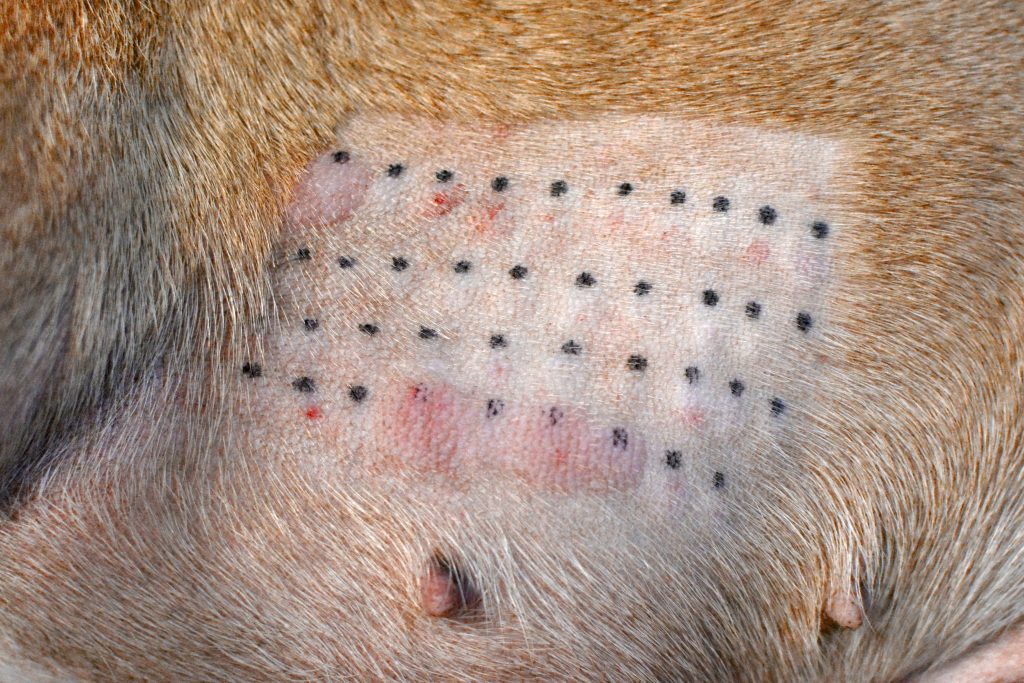
Intradermal Testing (IDAT) skin results
We thought you would be interested to read our other articles on Allergies. Allergy panel results explained, Allergy Medications for dogs and Food Allergies and Elimination Diet.
We found this article on the Davies The Veterinary Specialists website on allergies that we thought you might find useful.
With allergy dogs, you can also find that their behaviour changes when they are having a reaction. They become hypersensitive to touch, hyperstimulated, and hyperactive and you will find they demonstrate more ‘naughty/cheeky’ behaviour, such as stealing items, stealing food, and getting over-excited with play. During the flare, they lose the ability to switch off and be calm, similar to over-tired toddlers who have had too many E-numbers or sugar. Once the reaction subsides then their behaviour returns to normal.
A note on the medication withdrawal and allergy testing
Below are the general guidelines for medication washout periods (the length of time between stopping the medication and the immune system returning to ‘normal’) prior to serum-based allergy testing and intradermal allergy testing. Some general guidelines for medication washout periods prior to intradermal allergy test and serum-based allergy testing are as follows:
- Injectable steroids (long-acting) – 90 days
- Oral steroids including Vanectyl P, Prednisone, etc. – 30 days
- Steroidal skin, ear, and eye ointments (topical therapy) – 14 days
- Antihistamine medications (Piriton, Benadryl, Reactine, etc.) – 7 days
- Tranquilizers including Acevet, Atravet, Clomicalm – 7 days
- Oral & topical essential fatty acids including fish oils – 7 days
- Medicated baths – 5 days
The following medications do not generally need to be discontinued prior to allergy testing unless advised otherwise by your veterinarian:
- Antibiotics
- Antifungals
- Flea Preventive Medications
- Atopica (Cyclosporine)
- Apoquel **
- Thyroid Medication
- Anti-Seizure Medications
- NSAIDS (Non-Steroidal Anti-Inflammatory Drugs)
- Glucosamine
- Heart Medications
** Authors Note: certainly with Apoquel (and possibly atopica/cyclosporine so long as it is not being used to control Inflammatory Bowel Disease) we would recommend talking to your vet about stopping the medication before having any allergy tests, my own dog was on apoquel and had allergy testing and the Lab report stated that the results may not be completely reliable because she was on apoquel at the time the bloods were taken for allergy testing. After speaking with an allergy specialist about food trials, they also suggested that cytopoint should also be stopped because in theory anything that either dampens down the immune system response or modulates the immune system’s response will potentially produce inaccurate results for the food trial.